Published · Details checked
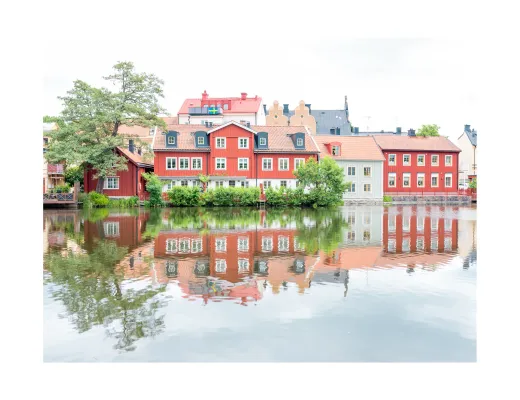
Munktellstaden’s brick workshops along the Eskilstunaån river now house museums, art, sports and restaurants.
The waters of the Eskilstunaån river tie together the entire industrial history of the city. When the rapids between Lake Hjälmaren and Lake Mälaren powered water-driven hammers and workshops, they laid the foundation for the town first known as Karl Gustafs stad, later the Free Town (Fristaden, 1771), and in the 19th and 20th centuries Sweden’s capital of cutlery and mechanical engineering.
The Rademacher Forges – where fine smithing took shape in 1658
Start the walk at the Rademacher Forges between Fristadstorget and the river. In 1654 the Livonian merchant Reinhold Rademacher received a royal charter to establish fine ironworks for knives, scissors, locks and needles, and in 1658 the works moved to Eskilstuna. Six timbered 17th-century forges remain in their original setting today.
The quarter serves as an open-air museum year-round. The Berglind Forge shows how a smith’s family lived and worked in the mid-19th century, while neighbouring cottages house working artisans, knife makers and Jernberghska Gården for lunch and coffee.
Faktoriholmarna and Eskilstuna City Museum in the historic rifle factory
From the Rademacher Forges, footbridges lead straight out to Faktoriholmarna in the middle of the river. Here stood the Carl Gustafs stad Rifle Factory, with roots in the 1600s and arms production from the early 1800s. Today the historic factory halls house Eskilstuna City Museum with free admission, a steam engine hall, an overhead belt-driven machine shop and exhibitions on the Free Town.
If you are visiting with children, Lilla stadsmuseet (the Children’s City Museum) on Faktoriholmarna is one of the city’s best-loved indoor spaces, where children can test gears, levers, pulleys and belt drives hands-on.
Munktellstaden with the Munktell Museum and Eskilstuna Art Museum
Continue across the bridge into Munktellstaden and step into the red-brick industrial district that grew after Johan Theofron Munktell opened his workshop in Eskilstuna in 1832. At the Munktell Museum (Munktellstorget 3), Sweden’s first steam locomotive Förstlingen (1853) stands alongside the first Swedish farm tractor (1913), steam engines and a vast hall of machinery from Munktells, Bolinder-Munktell, Volvo BM and Volvo Construction Equipment.
Across the square at Portgatan 2 lies Eskilstuna Art Museum inside a former 1917 gear factory. The museum offers free admission and one of Sörmland’s foremost collections of Swedish art from the 17th century to the present. The same building also houses Restaurang P-2, serving weekday lunch right inside the historic industrial hall.
Common questions
Which museums in Munktellstaden and on Faktoriholmarna have free admission?
Eskilstuna City Museum on Faktoriholmarna, Eskilstuna Art Museum in Munktellstaden and the outdoor grounds of the Rademacher Forges have free admission. The Munktell Museum charges SEK 100 for adults (children up to 16 enter free with an adult).
How far is the walk between the Rademacher Forges and Munktellstaden?
It is only about 800 metres along the Eskilstunaån river and across the footbridges via Faktoriholmarna, roughly a ten-minute walk.